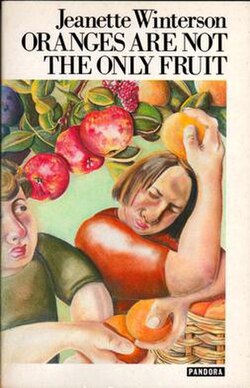
Oranges Are Not The Only Fruit: A Groundbreaking Exploration of Faith and Identity
Jeannette Winterson's debut novel, Oranges Are Not The Only Fruit, published in 1985, stands as a literary landmark, celebrated for its unique blend of memoir, fiction, and fairy tale. This semi-autobiographical masterpiece delves into the tumultuous coming-of-age story of Jeanette, a young girl adopted into a fervent Pentecostal Evangelist household. More than just a personal narrative, the book bravely navigates the complex interplay between unwavering religious belief, the awakening of an individual's sexuality, and the profound act of defiance required to live authentically. It's a powerful and often poignant look at how one person's truth can clash with the deeply ingrained convictions of their family and community, cementing its place as a significant voice in modern literature.
The novel garnered immediate critical acclaim, not only for its lyrical prose and innovative structure but also for its unflinching honesty. Its triumph was underscored by winning the prestigious Whitbread Award for Best First Fiction, and its enduring relevance was further solidified by a successful television adaptation in 1990. At its heart, Oranges Are Not The Only Fruit asks readers to consider the boundaries of faith, family, and self-acceptance, challenging conventional notions and celebrating the courage to forge one's own path, even when that path leads away from everything you've ever known.
The Genesis of Defiance: Jeanette's Early Life and Religious Upbringing
From the outset, Jeanette's world in Oranges Are Not The Only Fruit is painted with the vibrant, yet often suffocating, hues of an evangelical upbringing. Her adoptive family consists of a hard-working, largely absent father and an overwhelmingly present, intensely religious mother. This matriarch is the spiritual bedrock of their home and the local Pentecostal church, her faith so absolute that it dictates every facet of their lives, from daily routines to Jeanette's very purpose. Jeanette's mother believes she adopted her specifically to devote her life to God, a heavy burden for any child, particularly one beginning to grapple with an identity that directly contradicts church doctrine.
Early on, Jeanette begins to understand that she is different. She finds herself drawn to women, a realization that clashes violently with the teachings of her conservative community. This nascent understanding is starkly highlighted when she seeks kinship with two women who run a local paper store, only for her mother to forbid these friendships, declaring they harbored "Unnatural Passions." The church itself, a central pillar of Jeanette's existence, becomes a source of both spiritual guidance and profound judgment. During one memorable service, Pastor Finch, after a sermon on the holy number seven, subtly casts Jeanette as a potential harborer of sin by preaching on the evil of the number two, an early harbinger of the condemnation to come. These early experiences demonstrate the immense psychological weight placed upon Jeanette, caught between her innate self and the rigid expectations of her faith. To learn more about the novel's accolades, consider reading Jeannette Winterson's Whitbread Winner: Religion and Identity.
Even practical matters, like schooling, become battlegrounds. While Jeanette's mother initially disapproves of formal education, believing the Bible to be the only necessary text, an official mandate eventually sends Jeanette to school, exposing her to a world beyond the church walls. This widening of her perspective is crucial, as it introduces her to different ways of thinking and being. A poignant episode involving Jeanette's temporary hearing loss further illustrates the isolating nature of her upbringing. Believing her silence to be a sign of religious rapture, no one in her immediate religious circle notices her affliction until a perceptive Ms. Jewsbury intervenes. During her recovery, another church woman, Elsie, offers Jeanette a rare glimpse of unconditional care and mentorship, providing a much-needed human connection amidst the doctrinal intensity.
Unnatural Passions: Confronting Sexuality and Condemnation
As Jeanette matures, her "unnatural passions"—her lesbian sexuality—become undeniable, setting the stage for an inevitable and painful confrontation with her family and faith in Oranges Are Not The Only Fruit. The church, which once provided a sense of belonging and purpose, transforms into an instrument of profound judgment. Her mother, devout to the core, views Jeanette's sexual identity as a sin requiring repentance, a direct challenge to the life she had envisioned and ordained for her daughter. The narrative powerfully depicts the psychological warfare waged within the household, as Jeanette is pressured to conform, to pray away her desires, and to choose the path deemed righteous by her community.
Yet, in the face of such immense pressure, Jeanette's spirit of defiance emerges, strong and unwavering. She refuses to repent, choosing instead to honor her authentic self, a decision that comes at an extraordinarily high cost. This pivotal act of self-affirmation, while liberating, leads directly to her expulsion from the family home. The impact of religious beliefs on personal family affairs is laid bare, demonstrating how doctrine can override the most fundamental bonds of kinship. Jeanette's expulsion is not merely a physical removal but a symbolic severance from her past, forcing her to navigate a new world without the familiar structures and beliefs that had defined her existence. Her journey resonates with anyone who has had to choose between societal expectations and personal truth, highlighting the bravery required to stand firm in one's identity. This experience serves as a powerful reminder of the importance of self-acceptance, even when it means breaking ties with those you love.
Beyond the Pulpit: Literary Craft and Enduring Impact
Beyond its powerful thematic content, Oranges Are Not The Only Fruit is a masterclass in literary craft. Jeannette Winterson's narrative style is a bold and innovative fusion of genres that elevates Jeanette's deeply personal story into a universal exploration of identity and belonging. The novel seamlessly blends gritty, semi-autobiographical memoir with imaginative fiction and the timeless wisdom of fairy tales and fantasy. These interjected fairy tale sequences are not mere diversions; they serve as a unique narrative device, framing Jeanette's emotions and experiences, offering allegorical insights into her internal struggles and external conflicts. They provide a fantastical lens through which to process the often harsh realities of her life, allowing readers to delve deeper into her psychological landscape and the metaphorical underpinnings of her journey.
Winterson's ability to weave these disparate elements into a cohesive and compelling whole is a testament to her genius. The blend allows for a richer, more nuanced exploration of complex themes like faith, sexuality, and the nature of storytelling itself. This inventive structure undoubtedly contributed to the novel's critical success, culminating in the prestigious Whitbread Award for Best First Fiction. Its enduring relevance is further evidenced by its adaptation for television in 1990, introducing Winterson's profound narrative to an even wider audience. The novel continues to be studied and celebrated for its groundbreaking approach to narrative, inspiring countless readers and writers to find strength in their unique stories and to challenge conventional literary boundaries.
Symbolism and Significance: Why "Oranges" Matter
The very title of Jeannette Winterson's novel, Oranges Are Not The Only Fruit, serves as its most potent and central symbol. On a superficial level, it suggests variety, that there is more than one option. However, within the context of Jeanette's story, its meaning deepens significantly. Here, the "orange" comes to represent societal standards, particularly heterosexuality, which is often presented as the default or expected norm. Jeanette, as a lesbian, embodies "the other fruit"—a divergence from the perceived norm, an alternative that is equally valid and natural. This clever metaphorical framework immediately sets the tone for a narrative about non-conformity and the journey to embrace one's true self, even when it deviates from the mainstream. To delve deeper into this rich metaphor, you might enjoy Unpacking the Symbolism: Oranges in Winterson's Debut Novel.
This symbolism is not merely confined to the title; it plays out directly within the novel's plot. At a critical juncture, after a relationship has ended, Jeanette's former lover, Melanie, offers her an orange. Jeanette's refusal of this seemingly innocuous fruit is a powerful act of symbolic defiance. It signifies her unwavering commitment to her own path, her refusal to revert to what others might consider 'normal' or 'easier.' It underscores her decision to adhere to her own sense of right and wrong, independent of external pressure or the desires of others. This moment encapsulates the novel's core message: embracing one's unique identity, even when it means rejecting the familiar and expected. Winterson masterfully uses this simple, everyday object to convey profound truths about self-determination, autonomy, and the courage to live an authentic life. It's a reminder that true strength often lies in recognizing and celebrating the "other fruit" within oneself and others.
Oranges Are Not The Only Fruit remains an essential read for its courageous exploration of faith, identity, and the liberation found in defiance. Jeannette Winterson's semi-autobiographical narrative, enriched by its unique blend of genres and potent symbolism, offers a timeless reflection on the struggles faced by those who dare to live authentically in the face of societal and religious condemnation. It is a powerful testament to the human spirit's capacity for self-discovery and the enduring importance of individual truth.